


PPWR compliance
for businesses
Who does the PPWR apply to?
THE PPWR does not depend on “a type of company” but on two questions. Do you place the packaging on the market under your name or brand? Do you make the first sale of the packaged product in a country? Then you are the producer and you pay EPR. The same company can have both responsibilities, only one or neither, and that is exactly what we analyse with you.

Packaging manufacturer (conformity)
- You design or order the packaging under your brand, even if you do not physically manufacture it.
- You pack your product and put your label on it, even if a third party supplies the blank packaging.
- You manufacture generic packaging that other companies sell unbranded.

Product producer (pays EPR)
- You place packaged products on the Spanish market for the first time, under your own brand or a retailer’s brand.
- You import packaged products from outside the EU.
- You buy in another Member State to resell in Spain (intra-Community acquirer).
- You are a shop, bar or restaurant and you fill service packaging (cups, bags, trays) when handing over to the customer.

REQUEST INFORMATION ABOUT THE PPWR
What changes with the PPWR?
Main changes introduced by the EU Packaging Regulation
- Mandatory recyclability. From 1 January 2030, all packaging placed on the EU market must be recyclable (grades A, B or C). From 2035 it will have to be recycled at scale.
- Minimum recycled content. From 2030, plastic packaging must contain between 10% and 35% recycled material depending on its type. In 2040 the minimums rise to up to 65%.
- Reuse. From 2030 there are reuse targets for transport, beverage and e-commerce packaging. The hospitality sector must also allow customers to bring their own container.
- Minimisation. Packaging must have the minimum weight and volume necessary. In grouped, transport and e-commerce packaging, empty space may not exceed 50%.
- Harmonised labelling. From August 2028, a common EU-wide label will show the material composition to make sorting easier.
- Restricted substances. From 12 August 2026, PFAS are restricted in food-contact packaging.
- Technical documentation and EU declaration of conformity. Manufacturers must demonstrate that the packaging complies with the regulation before placing it on the market.
- Format bans. From 2030 certain single-use plastic packaging listed in Annex V disappears, such as single portions in hospitality or some wrapping for fresh fruit.
How do we help you?
- We analyse your company. We study your activity, products, markets and types of packaging.
- We identify your PPWR obligations. We determine which requirements apply to your organisation.
- We assess your packaging. We analyse the level of compliance and detect possible improvements.
- We design an adaptation plan. We define the actions needed to comply with the regulation.
- We support the implementation. We advise you while the measures are being put in place.
- Ongoing monitoring. We follow regulatory developments to keep your company up to date.

What do you want to assess?
Choose the self-assessment that best suits your needs and find out your company’s situation in a few minutes.
Packaging EPR self-assessment (in Spanish)
Find out whether your company is subject to Extended Producer Responsibility (EPR) for packaging and which obligations may apply to it.
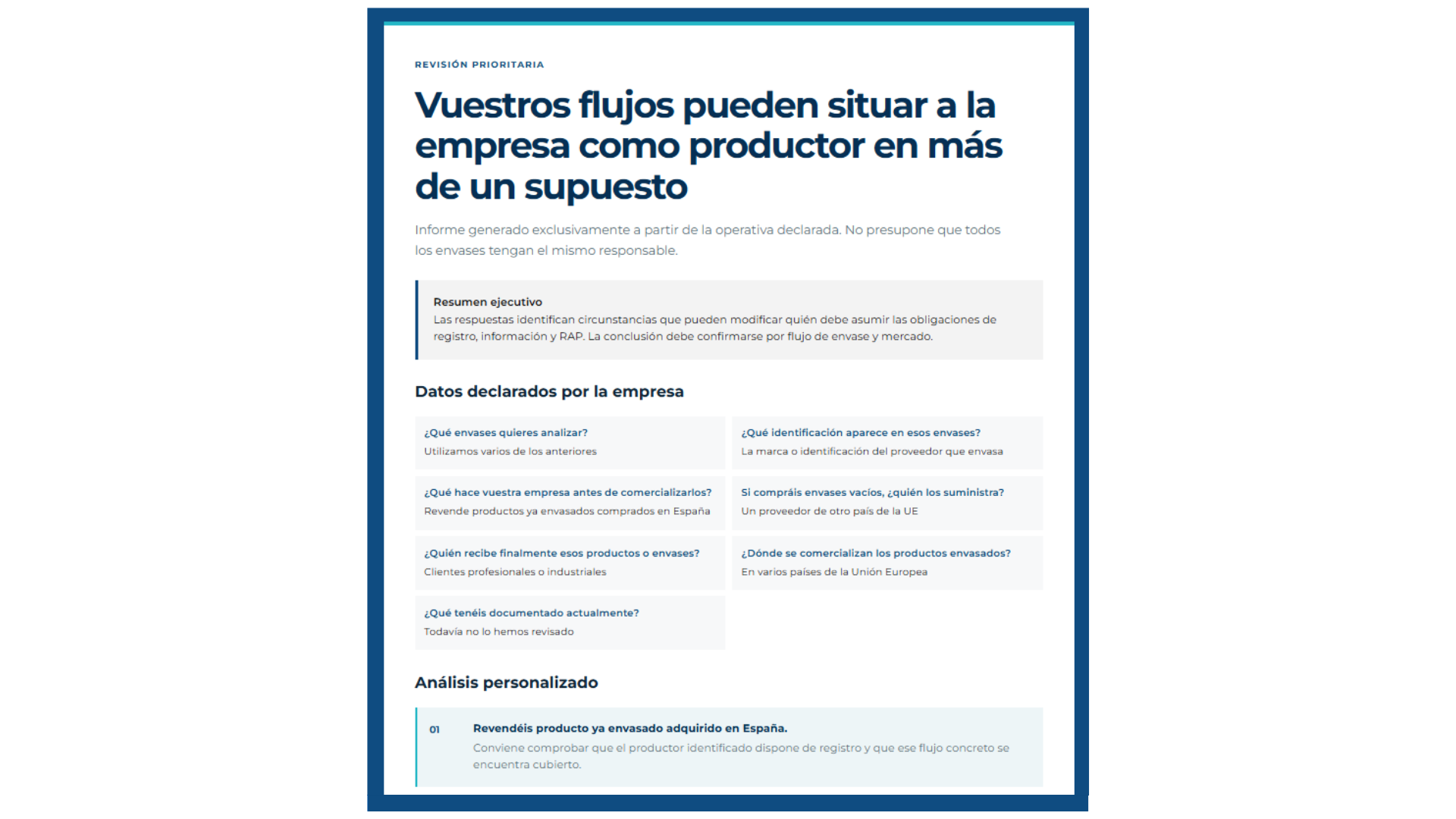
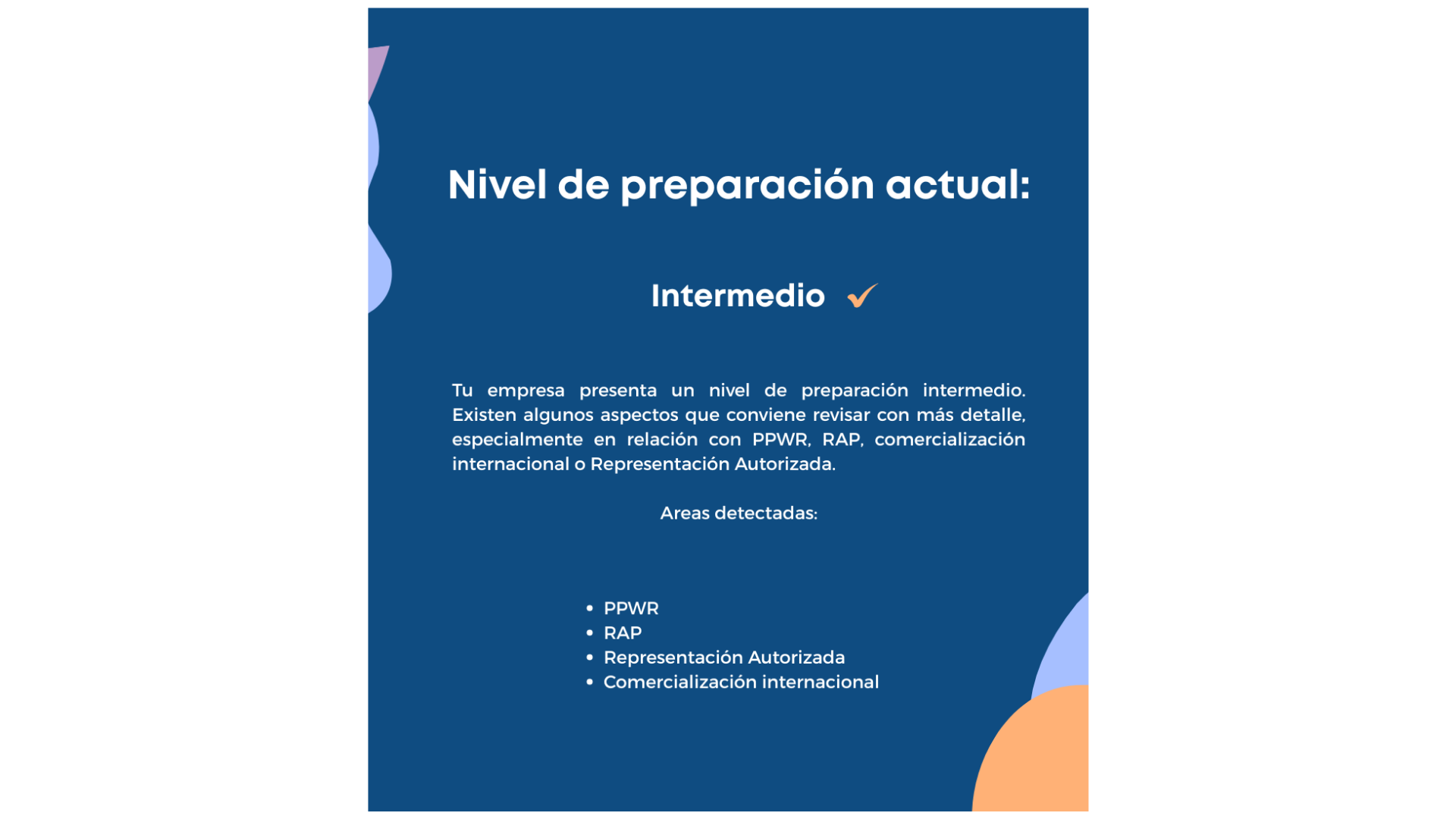
PPWR self-assessment (in Spanish)
Assess how the new EU Packaging and Packaging Waste Regulation (PPWR) affects your company and learn the main requirements you need to take into account.
What does our service include?
A comprehensive service for PPWR compliance
PPWR timeline
Frequently asked questions about the PPWR
The PPWR (Packaging and Packaging Waste Regulation) is the new EU Packaging and Packaging Waste Regulation. Its aim is to reduce the environmental impact of packaging through new requirements on eco-design, recyclability, reuse, recycled content and waste reduction. As a European regulation, it applies directly in all EU Member States, setting a common framework for companies that sell packaged products.
The PPWR affects manufacturers, importers, distributors and companies that sell packaged products in the European Union. It may also have implications for organisations that use household, commercial or industrial packaging. The specific obligations depend on the type of product, the packaging used and each company’s activity.
The Regulation introduces new requirements on packaging design, recyclability, use of recycled material, reuse, labelling and the technical documentation that proves compliance. It also sets new responsibilities for companies that place packaging on the market, so it is advisable to analyse in advance how these changes affect each organisation.
If your company manufactures, imports, distributes or sells packaged products in the European Union, the PPWR is very likely to affect it to a greater or lesser extent. The most effective way to determine the applicable obligations is to analyse the company’s activity, the markets where it operates and the characteristics of its packaging. If you still have doubts, you can take our free self-assessment (in Spanish) for an initial orientation.
Not necessarily. Each packaging item must be assessed individually to check whether it meets the new requirements of the regulation. In some cases small adjustments will be enough, while in others certain packaging will need to be redesigned or internal processes adapted. A technical analysis identifies the actions that are really needed and prioritises the adaptation work.
The PPWR aims to harmonise packaging rules across the European Union, but each country may keep certain procedures related to Extended Producer Responsibility (EPR), producer registers or reporting obligations. If your company operates in several markets, a specific analysis is advisable to ensure compliance with both the PPWR and the applicable national legislation.
At Heura we analyse how the PPWR affects your company and design a tailored adaptation plan. Our team identifies the applicable obligations, reviews your packaging, proposes the necessary actions and supports you throughout implementation so you can adapt to the regulation with confidence.
Our service includes analysing the applicable obligations, a technical review of your packaging, drawing up an adaptation plan, advice while the necessary measures are implemented and monitoring of regulatory developments related to the PPWR. The goal is to help you prepare your company to comply with the EU Packaging Regulation in a planned, efficient way adapted to your activity.
The PPWR entered into force on 11 February 2025 and has applied on a mandatory basis since 12 August 2026. From that date, many obligations kick in gradually: compostables and harmonised labelling in 2028, deposit return systems in 2029, and recyclability, recycled content and reuse from 1 January 2030.
Yes, insofar as it does not contradict the European regulation. Royal Decree 1055/2022 continues to regulate in Spain matters such as extended producer responsibility, the producer register, annual packaging declarations and business prevention plans. Provisions incompatible with the PPWR are displaced from 12 August 2026, so it is worth reviewing both regulations together.
It is our entry service. In an initial analysis we identify your company’s role (packaging manufacturer, product producer or both), which EPR and PPWR obligations apply to you in Spain and in other EU countries, and which actions you should prioritise. If you then want us to manage compliance on an ongoing basis, you can continue with our RAP Partner service.